Parkinsons And Parsis
Parkinson’s is the second most common neurodegenerative disease affecting 1% of the world’s population, over the age of 55, and is a common condition enslaving a huge number of people in our community. A research conducted in Mumbai revealed that a good number of Parsis are affected with Parkinson’s. Sadly, Parkinson’s is a progressive neurodegenerative disorders which worsens with time. But with recent advances in neurology and physiotherapy, the quality of life for the Parkinson’s patient can be enriched.
The Cause:
Our brain is made up of multiple cells called neurons. A set of neurons are responsible for secreting the hormone, Dopamine. When they fail in secreting the required quantity pulls the person into this condition. Recent research also shows genetic mutation cause for Parkinson’s. Environmental factors could also play a role
Diagnosis And Symptoms:
The diagnosis of Parkinson’s is purely clinical or according to the symptoms present. No two cases of Parkinson’s appear same. Symptoms vary in different individuals.
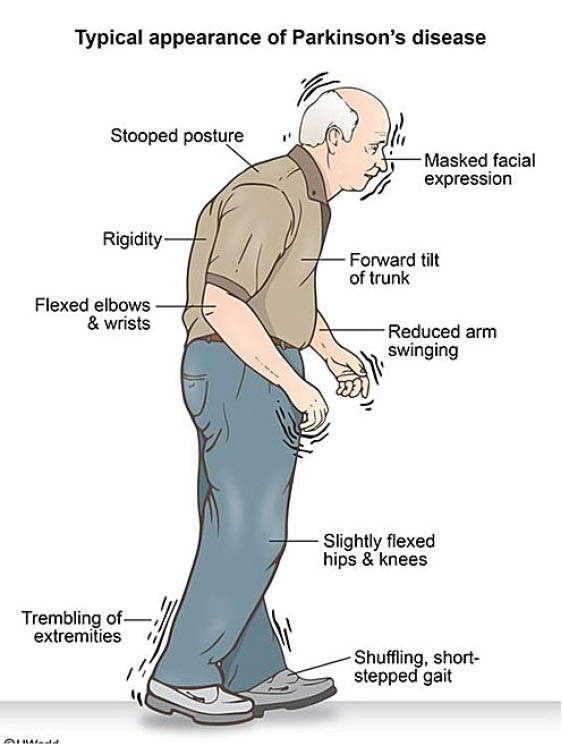 Symptoms:
- Rigidity: Stiffness in joints particularly shoulder and spine.
- Tremors: Shaking of body parts – hands or whole body tremors.
- Bradykinesia: An incapacitating problem causing extreme slowness of movement.
- Posture: A bent/stooping posture is characteristic of Parkinson’s. Loss of postural strategies (body’s natural responses to prevent falls) creates fear of falls which causes the patient to bend forwards in order to keep the centre of gravity (COG) low.
- Festinating Gait: Bent posture causes the COG, making the patient take small, fast steps for balance, leading to festination.
- Freezing: When patients come across narrow pathways or an obstacle in their way they suddenly stop moving and freeze at the point.
- Other Symptoms: Depression, anxiety, cognitive decline, constipation, loss of automatic and reciprocal movements, autonomic dysfunction including bladder disturbances, sweating, erectile dysfunction.
Management:
- Medical Management: What the body can’t manufacture is substituted in the form of medications
- Surgical Management: Deep brain stimulation surgeries are undertaken to stimulate the neurons to start secreting the hormone. Surgeries performed during the right phase can improve the quality to life to a great extent.
- Diet: Latest research shows that a mix carbohydrate and protein diet is beneficial.
- Physiotherapy Management: Regular Physiotherapy can effectively help in reducing the symptoms and slowing the progression of the disease.
Here are a few Physiotherapy Tips:
For Posture Correction: Since many of the symptoms follow postural dysfunction, the primary aim is to correct the posture by standing with the back against the wall heels touching the wall and bringing shoulder blades closer to the wall plus tucking the chin in. Maintain it for 1 minute, multiple times a day. Also inculcate stretching techniques by stretching the right hip and knee muscles.
For Strengthening: Back extensor muscles using hand push-ups.
- Hip extensors – Back kicks in standing, or raising the leg straight up and down while lying on the abdomen.
- Sitting and taking the legs up from the knee.
- Wall push-ups
For Balance Training: Multiple directional reach outs to objects while standing along with shifting weight from side to side in a rocking-movement of the body. Walkers should be used backwards instead of forward in order to keep the COG up and back. This helps a lot in solving the festination while walking.
For Tremors: Place your hands on the side of your body while sitting and shift body weight on either sides through the hands.
For Obstacle Training: Strip of tape stuck at the doorways. Different coloured tiling
Lines drawn at regular intervals in walking passage all help in overcoming the freezing episodes.
Also Note:
Music based movement therapy is a promising intervention. Moving with the music is enjoyed by patients over standard exercises.
Aerobic Exercises like static cycling/swimming have shown to help.
Breathing Exercises help maintain thoracic expansion and lung capacity.
Dual Task Training is an effective tool. Eg: talking while walking helps improve balance and also deals with depression.
Group Therapy is preferred to build up social interactions and motivation.
Assistive Device Tips: Raising toilet seats, Velcro closures instead of buttons or straps in clothing footwear etc., Grab bars, Built-up handles on eating utensils, Key holders etc. to minimise fine movement activity.
Interesting Facts:
- It may be interesting to note that males are more affected then females.
- People with extreme levels of controlling attitude, fear based personality, demanding nature and workaholics are more prone to get this disease.
- A study shows that people having coffee are less likely to get Parkinson.