The Ancient Ateshgah Baku Fire Temple Of Iran
 The Ateshgah Baku fire temple, located in the capital of Azerbaijan, was built over a natural gas vent, and constructed between the late 17th and early 18th centuries AD. There is evidence, however, that an older temple once stood at the site. One of the interesting features of the Ateshgah Baku fire temple are the inscriptions on the temple used by Zoroastrians, Hindus, and Sikhs. The Ateshgah has since lost its religious function and was converted into a museum during the 1970s.
The Baku Fire Temples were already in use in the 10th century AD. The Ateshgah Baku fire temple is located in Surakhany, a suburb of Baku, Azerbaijan. Due to the many natural gas vents under the Absheron Peninsula (where Baku is situated), fire rituals have been carried out in the area since the 10th century AD. The natural gas vents provided fuel for flames that could burn perpetually, the so-called “eternal flames.” This natural phenomenon can also seen at Yanar Dag (meaning “Burning Mountain”) near Baku.
Baku was once on the famous Silk Road . In addition to goods, this trade route also allowed news to travel from East to West, and vice versa. It is thought that through the Silk Road, merchants in India heard of stories about the Absheron Peninsula and its eternal flames. As a result, pilgrims from India began to travel to Baku to worship the sacred flames. At the same time, they brought their own gods to this foreign land, and worshipped them alongside these flaming gas vents.
The current Ateshgah Baku fire temple was built between the late 17th and early 18th centuries AD. When renovations were carried out in 1969, part of an older structure was found beneath the current temple. This suggests that the site was already used for religious purposes prior to the 17th century. Although it is speculated that the older temple extended beyond the perimeter of the current temple, this may be impossible to ascertain, since the remains were probably destroyed from the 19th century onwards as the surrounding area was excavated for oil and gas.
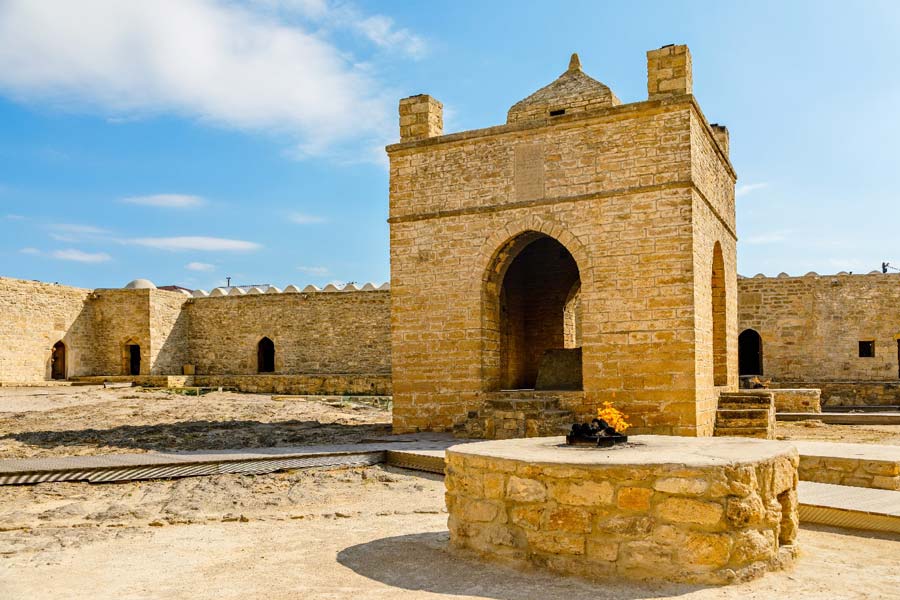
The Current Layout of the Baku Fire Temple: The current Ateshgah fire temple consists of a circuit of pentagonal walls surrounding a courtyard, in the middle of which is the altar. This altar takes the form of a pavilion and was built on top of a natural gas vent. Through the gases from this vent, the flame in the middle of the pavilion and four smaller ones on the rooftop corners are maintained. Within the courtyard, and around the altar, are small cells that provided accommodation for pilgrims and ascetics.
The architecture of the Ateshgah fire temple incorporates elements from both Zoroastrianism and Hinduism. The Ateshgah was initially established as a Zoroastrian temple, it developed into a predominantly Hindu site over time.
In addition to the Hindu architectural elements, the other sign of the presence of Hindus at the Ateshgah is the inscriptions dedicated to the Hindu gods Ganesha and Shiva. Apart from these, there are also inscriptions dedicated by Sikh pilgrims who came to the Ateshgah to worship. Although Ateshgah is also associated with Zoroastrianism, there is in fact only a single Zoroastrian inscription at the temple. In any case, the inscriptions indicate that the sacred site was shared by the three different religions.
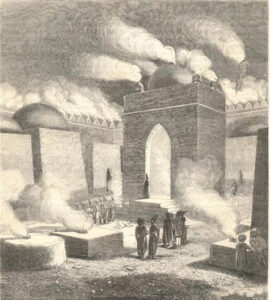 Pilgrimages to the site continue even today. By the late 19th century, the Ateshgah Baku fire temple was abandoned, possibly due to the decline in Azerbaijan’s Indian population. Nevertheless, even during that century, Parsis and Zoroastrians, who migrated to India following the Islamic conquest of Persia during the 7th century AD, continued to make pilgrimages to the site. Moreover, the site also became a tourist attraction for European tourists travelling in Azerbaijan.
As mentioned earlier, the Ateshgah Baku fire temple was renovated in 1969. Incidentally, in that same year, the eternal flame at the altar died, due to the intensive exploitation of the natural gas reserves on the Absheron Peninsula. Although the flame is still maintained today, its source of fuel is provided by Baku’s main gas supply.
In 1975, the Ateshgah was converted into a museum. The cells surrounding the altar, for instance, are used to tell the stories of the pilgrims who once travelled to the temple to worship.
As the Ateshgah fire temple is located in a suburb of Baku, it is not close to any of the city’s metro stations. Instead, there are buses that run from some of the stations to the site. Apart from that, one could also travel to the temple by taxi. The Ateshgah is open every day from 10:00 to 18:00, and tickets are required to enter the site.