
Aapri Parsi Bhasha
Parsis landed in India about 1200 years ago. The exact date of landing differs amongst scholars but that is not important. After the sugar and spice, and all that’s nice sort of episodes, we were allowed to stay in the kingdom of Sanjan, but with a rider, rather four riders – one of which was, we will learn to speak in the Indian language only. It is safe to conclude that the language meant was Gujarati. At first, the ‘Parsis’ as the locals called us, must have communicated in ‘Farsi’ with a few Gujarati words. With the passage of time Gujarati took over and a smattering of Farsi was fused into it. A lilt came into our Gujarati, some harsher inflexions were softened. Even now we use some Persian words without even realizing that they are of the Persian origin. Our own literature developed in what is today called the Parsi Gujarati. Today we speak ‘Parsi Gujarati’ with a smattering of English in it. It is evolving, it is a living language. Unfortunately with the passage of time some very fruity words, phrases and ditties are now being replaced by more sophisticated terms. Here are some Parsi terms which are no longer or rarely heard but were common about half a century ago…
‘Bucho’ or ‘buchi’ for a small boy or a girl. Eg: “Kem bucha, su karech? Lesson kar nahi-to Mehtaji ni eskol ma javu parse. Aaye buchi kon che?” Mehtaji’s school was a sort of school where children were sent to learn basic Gujarati and Arithmetic.
The word ‘dukhti’ was also used for a girl which was probably of Persian origin meaning girl or daughter. Similarly ‘dukhto’ became the masculine version for a boy or son, came into our Gujarati.
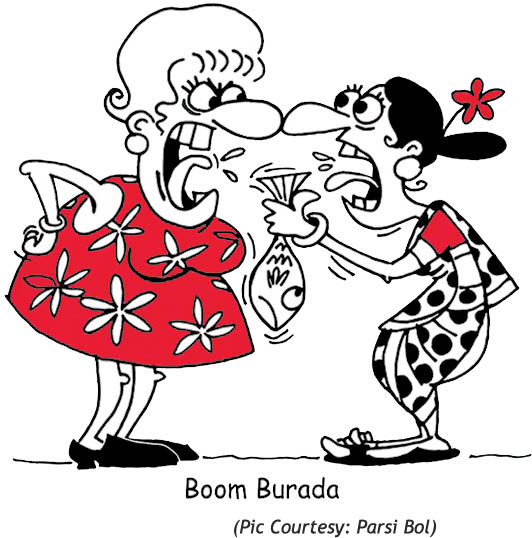 ‘Mai ghee’ or ‘Dudh pau’ meant sissy or a mamma’s boy.
‘Ponio’ was not a very manly person, a softy.
‘Pona aath’ (7:45) meant being slow on the uptake.
‘Trim taraak’ meant well dressed; ‘Jee-bharu’ means blessed. Eg. Mara jee-bharu Jamshedjee to trim-taraak thai ne dur ravivare ghora dorava (horse races) jaaye!
‘Gharara jevo’ or ‘Gharasia jevo’ is tall and handsome. This term probably has its roots in reference with the Grenadiers of the British army.
‘Choi Jevo lagech’ – The term ‘choi’ was used for the local darjee or tailor. Actually the term denoted a man wearing tight, ill-fitting trousers with very narrow bottoms.
An ‘Ichchamji’ is a man who overdresses gaudily and shows off. Eg: Mare-re! Ichchamji jevo taiyar thaich!
‘Kuchi’ is a door-key and ‘Pijan patlo’ means being repetitive. Eg: Ek-no-ek Pijan-patlo na kar! (Don’t keep repeating the same thing over and over again!)
‘Potanoj kak-ko kharo’ indicates only whatever he/she says is right, no-one else.
‘Houson-jhouson’ is the Hoi polloi or not very welcoming guests or people in big numbers. Probably a corrupt form of the English term, ‘Hobson-Jobson’.
‘Natru’ is a divorcee planning to remarry, commented upon as, “Mui natru karva challi!”
‘Pa. Cho.’ (Gujarati letters for a. p. and ch.) – Apoplexy. The greedy person’s cause of death will be apoplexy – “maran nu kaaran a.p.cho.” Similarly there was also a phrase – “Maran-nu kaaran dhakhara” for someone who had lots of pretentions.
“Chaas ma muro dovio” means committed a faux pas. And “Chekapie / capapie” means crazy – probably a corruption of the French ‘cap à pied’ meaning from head to foot. Almost similar to “Pavli kum.”
“Ghela ghanchi-nu kutumb” a family of idiots –sort of like the Hillbillies.
‘Velaat’ originally meant England. The term came in existence when the British posted in India would be returning to their homeland. They would be heard saying, “I’m going back to old Blighty!” Bligthy was a term lovingly used for England. When Indians heard this, especially their household staff, this term was corrupted to bilayat, vilayat and velaat.
Wearing a topi was a must at all times of the day. Those who did not wear it at night were told, “Topi nahi peher se to raatna saitaan avi-ne matha per taplo mari jase.”
Drinking toddy directly from the pitcher was called ‘Taans Marvi’, which was supposed to be the manly way of drinking toddy – only ‘dudh-paos’ sipped it from the glass. It was frowned upon by the countryside veterans!
‘Chhato-pani’ meant time for drinking. “Chhato-pani karve chalo!” meant the time for libation. Come let’s have a drink!
“Parvaarya ke?” – This term was often heard across the windows normally by noon time. Eg: “Kem Tehmina, parvarya-ke?” Or, are you done with your chores?
If there was a new-born child at home one could hear lullabies being sung in Parsi Gujarati such as “Ah ha mari Dolly tu, kavi mari dolly tu, Aapu tu-ne badhdha jee, raku pet-ma chapi; Dolly mari motti thai, motti thai nasal-e jai….” etc. There were songs and ditties for every occasion. There was yet another ditty recited by an old aunt or granny while children played hide and seek where the seeker’s eyes were held shut by the woman and others would hide. The lady would sing, “Naso-re goso-re, tu to maro doso re, doso gayo vaari, tya thi pidhi taari, taari pidhi garye (Pitcher), Doso gayo darye, Darye, darye laga chor…… Pillu chhut-tu?” The last line meant, now the chick is free. There was yet another one which was of a slightly violent nature. It went, “Vaat karo vaat, vaniya hata saat, ek-e maari laat, bijo gayo Velaat, tija-e maari chari, chotho gayo mari. Baaki rehya tran, so and so sathe pun, pun-hoi to pun, nahi-to saw rupiya dund!” And so on there are so many such fun ditties. These were in our own lingo and reflected our culture. Unfortunately, these days there is no one and no time to sit by the side of our tots and tell these gems. Both parents work, even the grannies who were once the repositories of our lore have become too sophisticated. They must ‘de-sophisticate’ themselves sometimes and tell the young ones of the good old days in the sweet tongue that is rarely heard nowadays. Save our Parsi Bhasha which is becoming more and more ‘Gujaratindi’ or ‘Gujaringlish’!



Hi Sir,
I would like the lyrics of dolly mari dolly to sing to my daughter.
Unfortunately my granny passed and my mother doesn’t know any of the monajats and lullabies.
It would be great to know of the same.
If there is a book/ online page where these are available it would be great.