The Divine Law Of Cause And Effect
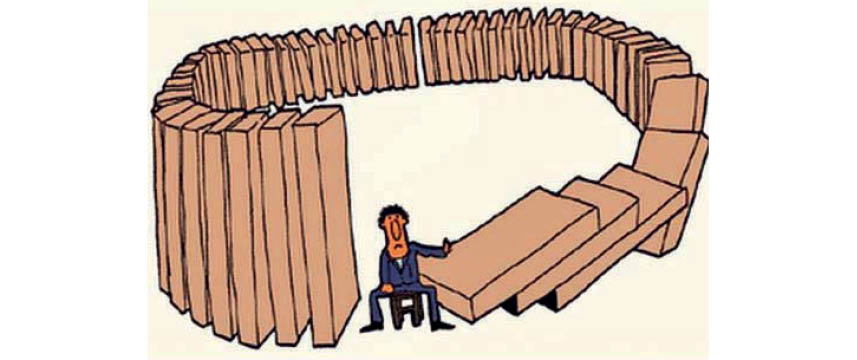
Why do bad things happen to good people? They happen because of their ‘Karma’. What do we exactly mean by karma? Is it a punishment? Is it a reward? No! It is payback through divine intervention, a universal method of checks and balances. It is divine-mathematics – a ‘spiritual law of cause and effect’.
It is an absolute law. Karma is impartial. You generate your own karma because you are the sum total of all your previous thoughts, words and deeds. Whatever we do with our body, speech or mind will have a corresponding result. Each action, even the smallest, is pregnant with its consequences.
Sceptics do not accept the law of karma; they believe that there is only one life-time. They think we come with a clean slate, and when we go, our slate is expunged. So whatever we do here and now, that’s all there is. If you do not understand the rational and scientific logic behind reincarnation, you cannot accept the law of Karma.
The mind you have created in your previous life determines the body you get in your next birth. Desires you have entertained, actions you have performed, all of these form part of the package you get in your next life. You are a bundle of Karmas that you carry from one life to the next.
There is evidence to prove that reincarnation occurs, but does everyone get incarnated? The answer is: That’s when you have to make a leap of faith. Evidence says that we are not just the body; we leave the body, we do not die or vanish with the body. In the Bhagavad Gita, Krishna says, “Shariram yat avatmoti, Shariram yat – avapnoti, yat-chapi utkramati-Ishwarah, Grihitva- etni samyati, vayurgandhani – iva ashayat.” The soul leaves the body at the time of death and moves on to the next body, but it carries vivid impressions of the previous life just as the breeze carries the fragrance of a flower.
In a set of Russian dolls, you open one, and you get one more doll inside. This is how we are – the outer body is a gross body. The doll inside the other doll is a subtle (astral) body. A subtle body cannot be cut, touched or seen through a microscope. At the time of death, the soul leaves the body carrying impressions of past lives.
When the subtle body has ‘sankalpa’ and ‘vikalpa’ or likes and dislikes, then it is called ‘manas’ (mind). When it discriminates between right and wrong, hot and cold, joy and sorrow, wisdom and foolishness, it is called ‘buddhi’ (knowledge). When it stores memories, it is called ‘chitta’ (wisdom). When the subtle body sees itself as separate from the world and all other creatures, then it is called ‘ahankaar’ (ego).
Buddha said, “Just as the arrow maker concentrates on the arrow that he is making to see that it is perfectly straight, the spiritual seeker spends his entire life focusing on how he can make his mind straight.” That’s why Krishna explains the world as ‘dukhalayam, asawatam’ – a place of misery where you cannot find lasting happiness. He says that nothing in the world is permanent, so you cannot find permanent happiness. Buddha said that the essence of life is suffering and no spiritual quest can begin until you have realised this essential truth. Everybody, who is spiritual, has gone through some degree of suffering. Suffering is not seen from outside but experienced within. Spiritual life is meant for people who have reached the irrevocable conclusion that in this world, there is no lasting happiness.
A belief in pure luck or predestination is not correct, for though it is a fact that there is luck or destiny, man himself consciously or unconsciously makes that destiny, is a master of his own fortune and gets happiness or misery, birth or death according to the ‘Law of Karma’, reaping in each life as he has sown in past lives. These and such other perplexities of life can be resolved only through an understanding of the law of karma. Bottom line… to a large extent, you are in control of your own ‘Karma’.