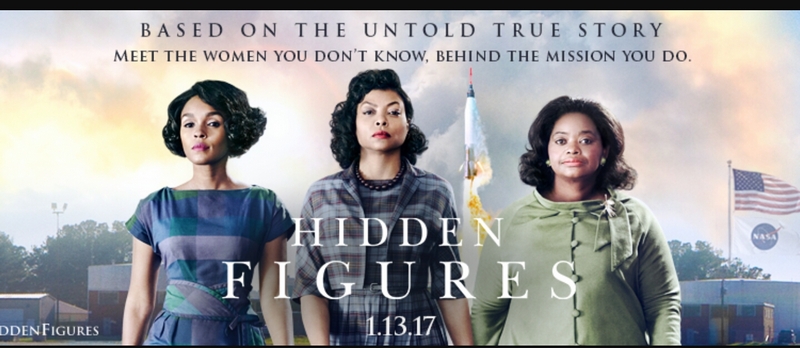
Film Review: Hidden Figures
The colour of the skin and the power of the human ‘computer’ are the mainstay of Hidden Figures, directed and co-written by Theodore Melfi and based on the book by Margot Lee Shetterly.
The film opens in 1926 in West Virginia, in an era and place when racism and segregation were prevalent in the US. Katherine (Lidya Jewett) is a maths child prodigy who grows up (Tanaji Henson) – cut to 1961 – and tries her hand as an engineer at NASA institute. This, at a time when the Commies and the Capitalists were in a race to send humans into space and on the moon. The pragmatic Katherine fights all odds – gender, racism being the most obvious – to invade the predominant ‘men only’, ‘whites only’ bastion at the NASA fortress.
Donothy Vaughan (Octavia Spencer) is another black (Negro / Negress being the most accepted terms then) who aims to be promoted to the post of a supervisor at the institute, her boss Vivian Mitchell (Kirsten Dunst) even tacitly admitting that she performs the duties of one.
Completing the triumvirate is Mary Jackson (Janelle Monae), who, aspiring to be an engineer, persuades a judge to permit her to be enrolled in a night school meant exclusively for white males.
Hidden Figures is a remarkable film about three extraordinary black women who breached the barriers and stormed the citadels, a good half century before the first coloured man occupied the White House.
There are some fine performances by the three, as also from Kevin Costner as the gum-chewing Al Harrison, who takes the impromptu decision to allow Katherine into the exclusive boardroom where her analytic geometry skills would be the crucial factor in John Glen’s (Glen Powell) piloting Friendship 7 into orbit.
The film is replete with some telling scenes – the car breakdown incident where a suspicious cop turns supportive; Johnson’s coffee jug in the office being labelled ‘colored’; or when she is forced to use the bathroom in another building of the NASA complex since there is none for the colored at her place of work.
But the most effective dialogue comes when one of them says ‘every time we get a chance to move ahead, they move the finish line’.
A few gaffes notwithstanding — as when the term UTC (Universal Time Coordinated) is mentioned, GMT being the established term in the 1960s and the broadcaster mentioning ‘at an altitude of 16000 miles per hour (sic) – the film is certainly worth a watch.